Pages

Thursday, March 12, 2020

15 -- Back to the Lake Chapter 10 -- Compare and Contrast

Image result for distance learning

Good morning, everyone!  Today begins distance learning for EL199A.  I am going to try to make this as simple and user friendly as possible.  We will get through the upcoming weeks together. 

Image result for journalJournal: Compare or contrast what life was like for you before the Coronavirus to what it is like now. You can make lists of similarities and differences, or you can write two paragraphs.

Read (if you haven't already done so) Back to the Lake Chapter 10 "Comparison and Contrast"
Complete Now: Compare and Contrast ARO below and email to me at holmstedt_k@mitchell.edu by the end of today. Otherwise it will be marked late. 
Be sure to make a copy of the ARO before you start typing. 
ARO for Chapter 10 in Back to the Lake

Read: "Two Views of the Mississippi" by Mark Twain
Click on the link to read the story.
"Two View of the Mississippi  
In this story, Twain compares how he viewed the river when he was younger and then when he was older.  He contrasts his young/old views in paragraphs 2 and 3. 

Write: Due: Friday, March 20 -- People of different ages sometimes see things differently. Write (one page) about ONE attitude (toward school/education, technology, television, video games, work, religion, sports, the law, and so forth) that you think is different for people who are older (parents' age). If you can, talk to one or two of your peers as well as your parents to see if your understanding of the difference is accurate. Write one page using the block compare-contrast format. In other words, put your (and your peers) description of your attitude in the first paragraph and the adults' attitudes of the same thing in the second paragraph.

Say your block compare and contrast is about technology. In the block method, describe your opinions about technology. In the second body paragraph, describe your parents' opinion. Should have an introduction and conclusion as well. 


Monday, March 9, 2020

14 -- Persuasive Essay Due and Start Compare and Contrast

Image result for welcome back
Collect Persuasive Essays

Turn and talk: What is a compare and contrast essay? What does it mean to compare? To contrast? How do we do it (compare and contrast) in life? Be prepared to give examples ...

Journal: What does your morning routine look like? Start with waking up, .... Share and compare and contrast with the person next to you.

Introduce Compare and Contrast (final essay)

A compare-and-contrast essay analyzes two subjects by either comparing them, contrasting them, or both. The purpose of writing a comparison or contrast essay is not to state the obvious but rather to illuminate subtle differences or unexpected similarities between two subjects. 

What's the difference? this question gets to the heart of comparison and contrast, and it is a question that can fit into any context. In day-to-day life, it implies the process behind most decisions: "What shall I wear?" "Which movie will I see?" "Should I change jobs?" All these questions involve choices that draw on comparison and contrast. Like narrative and persuasive essays, comparison and contrast forces you to observe, but here you are looking for similarities and differences. 


Image result for fast food restaurantsWhether you stress differences or similarities, you need to be sure that the comparison is fair. Deciding where to go out to dinner often depends on how much you are willing to spend, so comparing a fast-food place to an elegant French restaurant doesn't have much of a point unless you want to treat the comparison humorously. If neither is worth the money, however, you've established a similarity that gives you a serious assertion to work with. 

How can you shape comparison and contrast for your readers?
Often you may want only to inform your reader; that gives you at least three possible theses:

x is better or worse than y.
x has a lot in common with y, though not obviously so.
x is quite different from y, though superficially similar. 

Comparison can be used to persuade and to entertain your readers. A seemingly simple job such as washing the dog can be as much of a challenge as performing major surgery. As least at hospitals, you don't have to catch the patient first.

How can you use analogy? An analogy is an extended metaphor or simile in which a primary term is equated with another quite dissimilar term. An analogy can emphasize a point or illuminate an idea. https://literarydevices.net/extended-metaphor/

How can you structure your essay? Comparison and contrast essays group information so that the comparison is made by blocks or point by point or by a combination of the two. If you were to write an essay explaining the differences between an American feast, such as Thanksgiving, and a Chinese one, here is what the two major types of organization look like in outline form:

Type          Structure                           Content
Block         Paragraph 1                         Introduction
                  Block A, paragraphs 2-4     American culture
                       Point 1                                 Preparation
                       Point 2                                 Courses/types of food
                       Point 3                                 Manners
                  Block B, paragraphs 5-7      Chinese culture
                       Point 1                                  Preparation
                       Point 2                                  Courses/types of food
                       Point 3                                  Manners
                 Paragraph 8                            Conclusion

Point by 
Point         Paragraph 1                            Introduction
                  Point 1, paragraph 2              Preparation
                                                                      Chinese 
                                                                      American
                  Point 2, paragraph 3              Courses/types of food
                                                                       Chinese
                                                                       American

And so on. As you can see, sticking rigorously to one type of organization can become boring or predictable, so writers often mix the two. 

* Examples of block structure and point by point

Basic Essay Structure
https://www.youtube.com/watch?v=7P4fzbzwwAg

Pointers for Using Comparison and Contrast

Exploring the Topic

Image result for exploring1. What are the similarities? What characteristics do your two subjects share? Are the two so similar that you have little to distinguish them? If so, try another subject; if not, pare down your list of similarities to the most important ones.

2. What are the differences? In what ways are your two subjects different? Are they so different that they have little in common? If so, make sure you can handle a humorous tone or try another subject; if not, pare down your list of differences to the most important ones.

3. Should you emphasize similarities or differences? Which pattern of organization best fits your material? Block? Point by point? A combination of the two?

4. What examples work best? If your reader isn't familiar with your topic, what examples might be familiar? What examples will make clear what may be unfamiliar?

5. What metaphor does your subject suggest? Given the metaphor and your subject, what characteristics match? How can the metaphor be extended into an analogy? How can you outline the analogy as an equation? What equals what?

6. What other modes are appropriate? What modes can you draw on to help support your comparison and the organization of the essay? Do you need to define? Where can you use description? Narration? Example? 

7. What is your point? Your purpose? Do you want to entertain, inform, persuade? Given your point as a tentative thesis, should you spell it out in the essay or imply it? If you are writing to inform, what information do you want to present? If you are writing to persuade, what do you want your reader to believe or do?

8. What persona do you want to create? Is it best for you to be part of the comparison and contrast or to be an observer? Do you have a strongly held conviction about your subject? Do you want it to show? Does your persona fit your audience, purpose, and material?

Discovering similarities and differences 

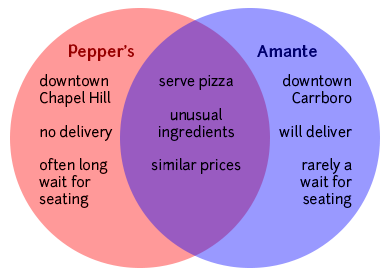
Making a Venn diagram or a chart can help you quickly and efficiently compare and contrast two or more things or ideas. To make a Venn diagram, simply draw some overlapping circles, one circle for each item you're considering. In the central area where they overlap, list the traits the two items have in common.  Assign each one of the areas that doesn't overlap; in those areas, you can list the traits that make the things different. Here is a very simple example, using two pizza places:


Make your own Venn diagram comparing or contrasting two things. https://www.thoughtco.com/creating-a-venn-diagram-1857015

Homework: Read Back to the Lake  Chapter 10 Comparison and Contrast, pages 335-347.  

In Friday's class: Be prepared to complete an Active Reading Outline (ARO) for Chapter 10. We will read the essay, "Singing Like Yma Sumac." I will provide handouts of this essay in class. I will also distribute the compare and contrast essay assignment.

Thursday, February 27, 2020

13 --Peer Review of Persuasive Essay


Didn't peer review. Not doing this anymore with this class.

Journal: Describe an outdoor game you used to play in the summer.

Peer Review of Persuasive Essay

Monday, February 24, 2020

12 -- Read Chapter 2 of They Say I Say

Activity #1
Opposing Viewpoints in the library's database
Find your topic and see what you can add to it.
If your topic isn't in the database look for another related topic. Or maybe you need to change your topic to something that has more substance. 

Activity #2
Journal: Write about a time when you performed an act of kindness or helped someone solve a problem.

Activity #3 
Chapter 2 of They Say I Say -- "Her Point Is"

The Art of Summarizing
Image result for conversation

  • To argue persuasively you need to be in a dialogue with others. Being able to summarize others' arguments is central to your arsenal of basic moves (30).
  • A good summary requires balancing what the original author is saying with the writer's own focus. Generally speaking, a summary must at once be true to what the original author says while also emphasizing those aspects of what the author says that interest you, the writer. Striking this delicate balance can tricky, since it means facing two ways at once: both outward (toward the author being summarized) and inward (toward yourself) (31). 
On The One Hand, Put Yourself in Their Shoes


  • To write a really good summary, you must be able to suspend your own beliefs for a time and put yourself in the shoes of someone else (31).
  • Writing theorist Peter Elbow calls this the "believing game," in which you try to inhabit the worldview of those whose conversation you are joining -- and whom you are perhaps even disagreeing with -- and try to see the argument from their perspective (31).
  • pages 32 and 33 about summarizing Z and Martin Luther King Jr.
On The Other Hand, Know Where You Are Going


  • While summarizing another text requires you to represent fairly what it says, it also requires that your own response exert a quiet influence. A good summary, in other words, has a focus or spin that allows the summary to fit with your own agenda while still being true to the text you are summarizing (34).
  • bottom of page 34 -- Z
  • page 35
  • page 39 -- Use Signal Verbs That Fit The Action

Activity #4
Read a Crime of Compassion and respond to questions.
http://classwithrestivo.com/wp-content/uploads/2014/09/a-crime-of-compassion.pdf

Persuasive essay is due the Tuesday after spring break.

Image result for happy spring break